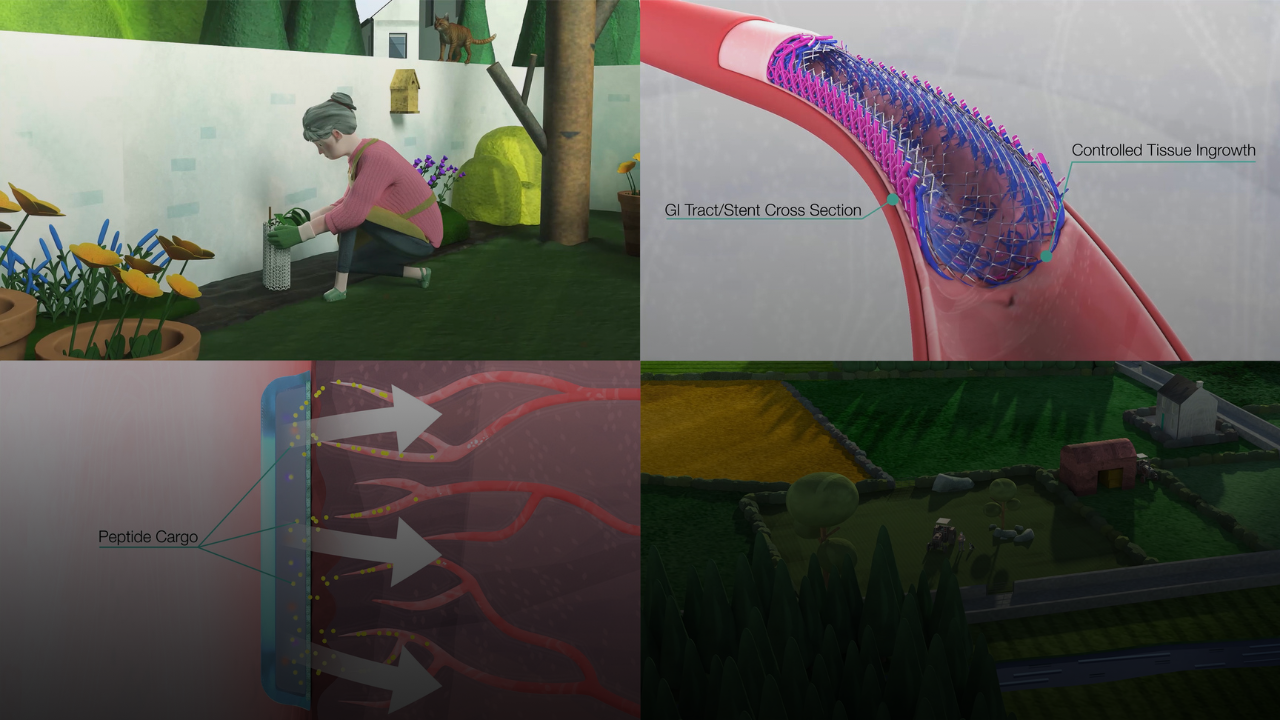
Ardán and CÚRAM in collaboration with the National Talent Academy for Animation are delighted to announce a new callout for Science on Screen animation commissions.
Animators are being sought to create short, one-minute 2D animations, to explain research projects being developed at CÚRAM, a SFI Research Centre for Medical Devices based at University of Galway. The goal is to create animations which can communicate complex ideas in an easy-to-understand way for public and patient audiences.
CÚRAM have outlined four projects which will each have an animation created for it. Each project will have a total budget of €4,000, a duration of 50-60 seconds and a time frame of 14 weeks to complete. Animators will receive mentoring during the process which will be facilitated by the National Talent Academy for Animation.
The animator will be provided with a draft script for the animation and will work with the research team to develop and produce the final piece, receiving feedback throughout the process from CÚRAM, Ardán and National Talent Academy for Animation.
Previous animations made can be found here.
Guidelines
-
Animators can apply as an individual or as a team.
-
Applicant(s) must be habitually resident in Ireland.
-
Applicant(s) must be 18 years of age or over.
-
Applicant(s) must be able to show through their portfolio their ability to create a high-quality animation which can represent the Science on Screen brand.
-
Animators may be offered the opportunity to produce more than one project.
-
Animators can nominate areas in mentorship they would like to receive.
-
Students in full time education are not eligible to apply.
-
The deadline for receipt of applications is 5PM on Thursday 7th December 2023.
Requirements
-
Cover Letter
-
Project Outline including mood board for one or more of the research projects
Note: Applicant(s) can express an interest in a specific research project but this doesn’t guarantee they will be assigned it. -
Director / Producer Notes including vision, production method and time scale of project
-
A CV for each member of the team (PDF format) containing relevant experience.
-
Online link to the showreel, or previous animation work for each member of the team (PDF format).
-
Budget breakdown
-
Applicant(s) must be available for online interview on 10th / 11th January 2024
-
Applications can be made via this Form (questions can be sent to kenny@ardan.ie)
The projects available for animations are:
Project 1
Solutions for Inflammatory Bowel Disease
Inflammatory Bowel Disease can cause continuous episodes of gut inflammation, surface erosions, ulcerations, and severe intestinal wall fibrosis. The standard treatments have focused mainly on maintaining the remission levels of the disease, using anti-inflammatory or immunomodulatory agents. However, these do not address the root cause of the condition.
This project aims to design a new hyaluronan hydrogel delivery system that can be injected into the lower bowel to protect the damaged gut wall by decreasing inflammation and permeability. This will act as a protective barrier to help manage inflammatory diseases in the colon.
__________________________________________________________________________________
Project 2
Biodegradable Coatings in Urinary Stents
The surface of urinary stents can be a breeding ground for bacteria which can cause discomfort for the patient, infection and encrustation of the stent. The removal of stents in these scenarios can cause trauma and further complications for patients.
We will aim to remove bacteria from the stents by using electrically polar materials known as pyro and piezoelectric materials with antimicrobial properties. These materials will introduce a constantly changing surface with electrical charges. Such a stent surface will be difficult for microbes to colonise. This would make removal of stents a safer and easier process for patients.
__________________________________________________________________________________
Project 3
Nature Inspired Adhesion Films
This project explores attachment of materials (either devices or medicines) to wet and dynamic biological surfaces for tissue repair or delivery of medicines. Existing bioadhesives made from hydrogels are usually either toxic or fragile, and their applications are often limited by low stiffness and toughness and non-adhesiveness in wet conditions. To find better solutions, the project is taking inspiration from nature. Examples of organisms being studied in this way are barnacles, found on the sea shore, which produce a complex of proteins that enable them to stick to different surfaces.
The team are aiming to reproduce these proteins to investigate their sticky properties for their potential use in tissue repair and drug delivery. Further inspiration is taken from a new class of bioadhesives based on amino acids with the aim of engineering them into bioadhesive polypeptide hydrogels that have specific cellular adhesive property. The animation will show how attaching materials to cells and tissues is possible via inspiration from nature.
________________________________________________________________________________
Project 4
Deep Brain Stimulation from Piezoelectric Electrodes
Focused ultrasound can be used to deliver energy deep into the brain without the need for invasive surgery. This project aims to create a miniaturized lens device that is biocompatible and can promote delivery of ultrasound with high resolution to a targeted region in the brain. This device would get rid of the need for invasive brain surgery and chronic device implantation for deep-brain stimulation treatment of conditions such as Parkinson’s disease.
________________________________________________________________________________
CÚRAM Background:
CÚRAM is a world-leading research centre funded through Science Foundation Ireland, with expertise in medical device technology. With ten partner universities and multiple industry partners, CÚRAM’s aim is to improve the quality of life for people suffering from chronic illnesses like diabetes, cardiovascular diseases, and Parkinson’s disease.
Medical device research and development is based on multidisciplinary research involving basic or discovery-oriented research through applied and translational science. Given the complexities involved, communicating about this research to public audiences can present a challenge for researchers.
Education and Public Engagement (EPE) is a core activity at CÚRAM and the EPE Team is involved in a variety of innovative programmes aimed at engaging all audiences with its research. Science on Screen (a partnership between CÚRAM and Árdan) is one of these programmes that provides opportunities for collaboration between our researchers and creative artists. These collaborative projects help create a better understanding and awareness of CÚRAMs research and its importance in and for society.
Since 2016, Science on Screen has produced eight short-form science documentaries based on the research being undertaken by CÚRAM researchers. These films have reached an audience of over one million people worldwide, earned six international awards and have been screened at over 30 film festivals in 17 countries.
Subscribe to our newsletter
This newsletter will keep you up to date with courses, activities, programmes, events, news, and resources related to the Irish screen sector from crew, film, and television to animation and VFX.
Subscribe